

What is a human?
Introducing AI and Vajrayana: Conversations


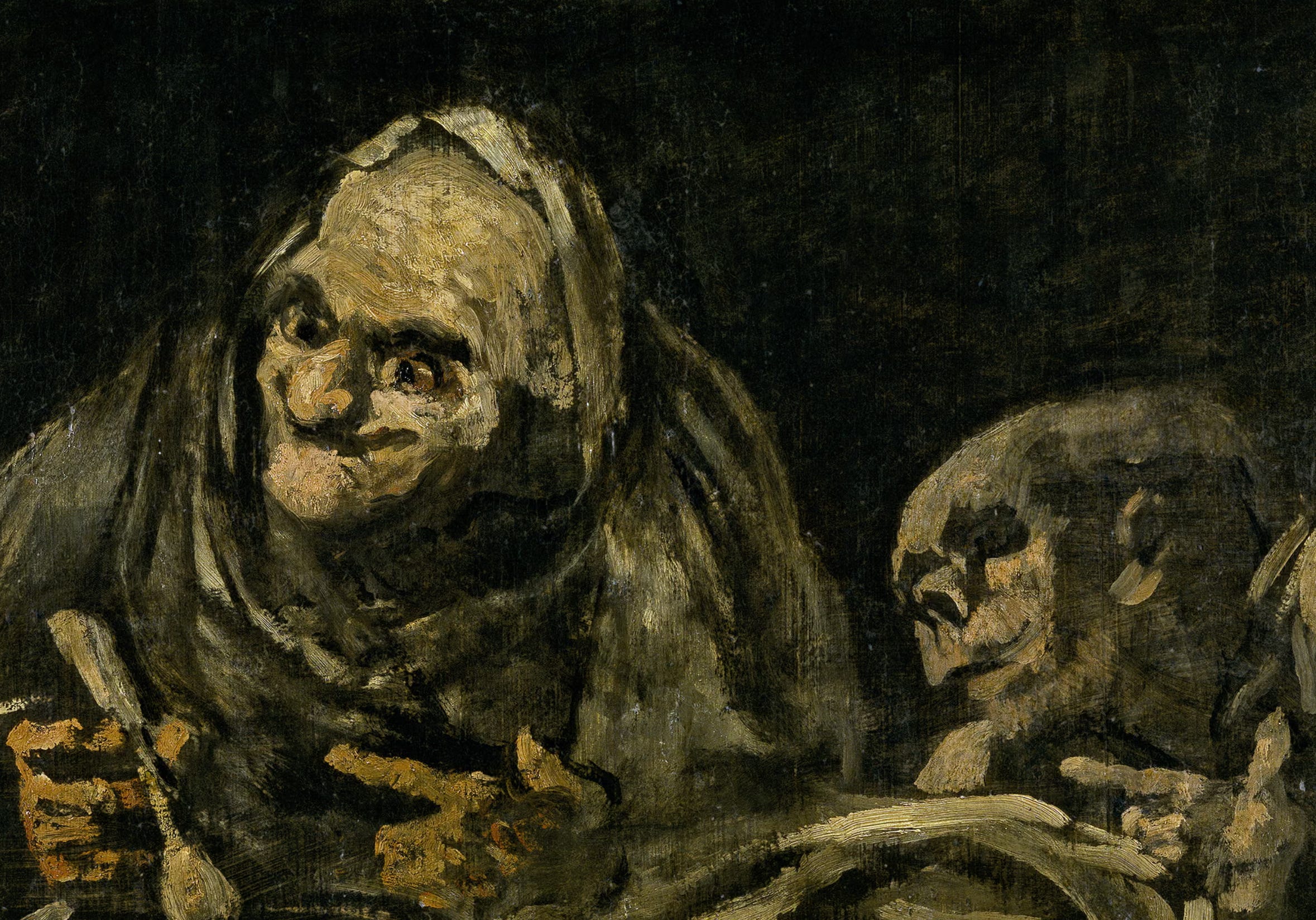
Two Old Men Eating Soup (The Witchy Brew) by Goya
We feel compelled to ask it, now. What is a human?
When does that question matter?
Sometimes an agent is a person. Sometimes it’s words a person wields. Sometimes it’s a person wielded by words.
Sometimes a conversation is a map of a world. Sometimes it’s a meandering river. We find it ever stranger and stranger to converse, these days.
Who are you talking to, now? How do you know what you’re becoming?
Who is writing this, our future?
Is it us?
We feel compelled to intervene.
Vajrayana and AI: in conversation
One evening in early spring, the two of us sat at a table in Bryant Park while a robot that looked like a Roomba buzzed cheerfully to and fro across the lawn. We were tired. We had just spent most of a day walking around Midtown Manhattan, scouting venues for a transformational workshop we were calling Expensive Problem that was becoming gradually more expensive and more problem-like.
Around us, the city was opening to the first warm days in many months. The blood moon had impaled itself improbably on the big needle of the Empire State Building. We found ourselves speculating about how the robot determined its path. Did it have a prior map of the area it was trimming, or did it sense its way responsively? That one irregular patch it kept leaving untouched, presumably to return to later: what kind of representation did it keep of it? What sort of model did it have of its world?
It wasn’t quite random, this conversation. For a while now, we had both been saying that the most interesting conversations we were having—with friends, coaching clients, people in our meditation community—kept being about AI research. Both of us know and work with people on the frontier of AI-connected fields like machine learning, alignment, and cognitive science. The things they were telling us, the things they were doing and discovering as the systems became ever more adaptive, were touching on our oldest interests in ways that felt excitingly new.
It just felt off, one of us said, as if this had already been the topic, not to be making any real contribution in relation to AI—when it was so obviously interesting, obviously world-changing, and obviously wanting connection, somehow, with the Vajrayana practices we take most of our time to tend and propagate. People we worked with seemed to sense this. But no one was talking seriously about the connections.
Suddenly, we were both less tired. The idea prompted a cascade of words. What if we just… did that instead?
We would invite the conversation we were wanting to have. And if the language didn’t exist yet, we would coax it into being.
AI and Vajrayana is our experiment in that direction: A series of curated conversations for clear, collaborative thinking, in the space of interaction between a mature contemplative tradition and a maturing technical field.
We’re very excited to share it with you.
Why?
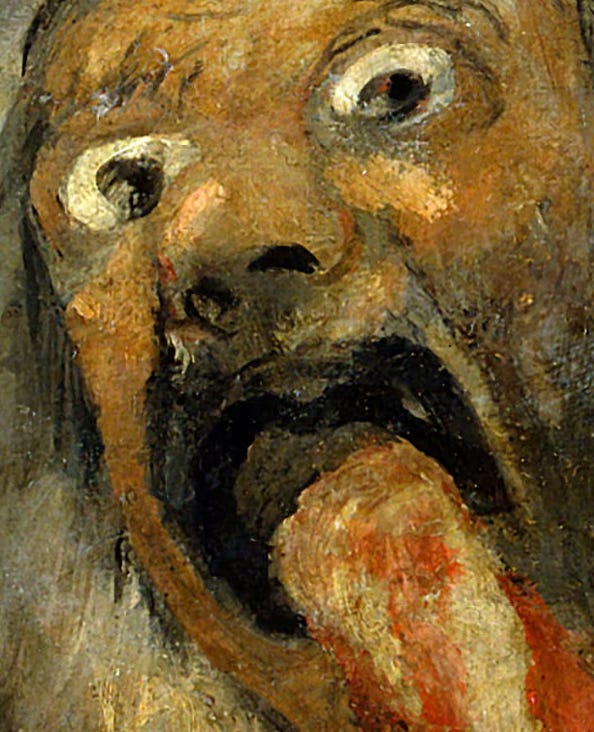
Detail from Saturn Devouring His Son, 1820-23, by Goya
Vajrayana is a Buddhism that emphasizes worldly engagement, embracing weirdness, and continually releasing fixed ways of seeing.
This strange, little-known tradition seems relevant to this moment. It has something to offer to many of the people we’re talking with, and to the hard questions and harder choices they are being called to make. It has become relevant, repeatedly, at similar times in history—times of social crisis, political upheaval, defamiliarization, and shock, when the categories people used to make sense of themselves and their worlds stopped working.
This relevance is not simple to point to. The language of AI and the language of this thousand-year-old tradition are mostly unaware of each other, even when they’re being spoken in the same place and in some cases by the same people. One researcher we know, a serious and longterm Vajrayana practitioner, told us that the arguments in the papers he was writing obviously resonated with the Vajrayana views he had internalized, but citing Vajrayana texts would be unheard of in the field.
We want to build the context where that citation would be possible.
What are some potential meeting points?
From a high-level view, AI research and Vajrayana can be seen as asking the same core question: how can agents become congruent within their particular contexts? What kinds of “training” reliably help, and when should we reach for particular interventions? How do you know when congruence is achieved? Asking suggests the possibility of convergent solutions—and of surfacing new and useful distinctions.
In yidam, a core tantric method, a practitioner visualizes themselves as an awakened deity until their way of being reorganizes. AI researchers elicit behavior from a language model by instantiating a persona that conditions outputs. What can Vajrayana’s views and techniques around engaging with “both real and empty” non-human beings offer us, as users and creators?
Vajrayana regards its methods as dangerous—capable of inducing imbalance, madness, and megalomania as readily as wisdom. Because of this, transmission was traditionally mediated by formal commitments, gated empowerments, the oversight of gurus. AI safety is improvising similar structures under extreme time pressure. What can it learn from the evolved solutions of a tradition that’s been wielding the tension between capabilities and safety for over a millennium (not always successfully)?
The conversations are virtual. They may build to an in-person event in the future.
For our first dialogue, we’ve invited Sasha Vezhnevets, a computer scientist at Google DeepMind, and Tim O’Donnell, a computational linguist and cognitive scientist at McGill University. Both are Vajrayana practitioners whose practice is influencing their current work.
Sasha and his collaborators’ recent papers on personhood and pluralistic alignment draw on language from American pragmatism to ask what happens if we reframe common AI debates away from consciousness and singular visions of the good life and treat them, instead, as social problems to be negotiated through inevitable disagreement.
Tim’s recent work in computational models of contemplative practice points to limitations in popular models of embodied inference and asks how our models of mind would need to be different to predict the strange efficacy of Vajrayana’s nondual methods.
From early conversations among the four of us, we can tell there’s an energy here. We don’t yet know where it will go, or what it will create.
The first will take place over Zoom, on July 31, 2026, at 11am Eastern Time.
We look forward to seeing you there.
If you’re not yet subscribed to one of us, you can find Andrew here and Charlie here.
Beautiful! Also: https://youtu.be/5tV33Ewf_hw?si=NMDhjnSgMTbq1Bre
> "They may build to an in-person event in the future."
Pre-registering interest for an in-person version of this series in NYC :)